
-
 News Uncategorised The fourth industrial revolution what can we learn from past revolutions
The fourth industrial revolution what can we learn from past revolutions
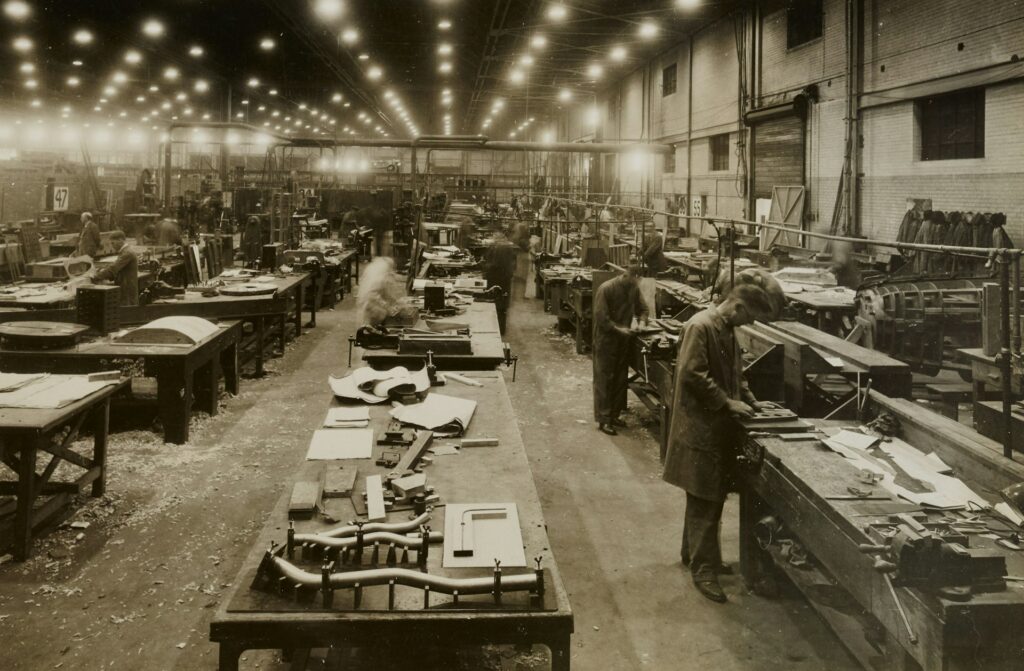
Technology isn’t just changing the world it’s consuming entire industries and occupations at a pace that feels relentless, even overwhelming. Innovation accelerates at astronomical speeds, leaving many struggling to keep up. The pressing question upon workers, professionals and anyone concerned about the future is simple yet profound: how do we thrive in this technology-saturated world that has brought us to the Fourth Industrial Revolution. Walk into a store to buy food and you will almost certainly pay electronically, navigating touchscreens, tapping cards and scanning phones. Read about companies downsizing and the explanation is increasingly algorithmic, AI doing work that humans once did. Call customer service and there’s a growing chance that the voice responding to your questions isn’t human, but a Large Language Model (LLM) trained to simulate human conversation. The Fourth Industrial Revolution is here, but history offers perspective. We’ve been through three industrial revolutions, each fundamentally transformed how humans lived and worked, ultimately, there are patterns waiting to be discovered.
The term Industrial Revolution (IR) refers to periods of transformative change in modern history, marking the transition from handicraft-based economies to ones dominated by industry, mechanisation and technology. While industrial revolutions can unfold gradually over decades, they fundamentally reshape how humans live, work and interact with the planet.
The First Industrial Revolution (Mechanisation) 1760-1840
The first industrial revolution began in Great Britain and spread to the USA and the rest of Europe, and was marked by the invention of the steam engine. This period was also characterised by resistance to mechanisation, including the Swing Riots and the Luddites, groups that intentionally destroyed factory machines like looms.
| Skill Category | Wage/Week | Role |
| Skilled | ~10s-15s | – Power loom operator |
| Highly-Skilled | ~30s-60s | – Machine makers – Engineers & Millwrights |
| Senior Management | ~£1.5-£4 | – Foremen & Overlookers |
Interestingly, skilled workers in the cutting-edge industry of mechanised textile production, operating power looms, earned between 10-15 shillings for a 14-hour workday, a wage that, by many contemporary accounts, was barely enough to survive. On the other hand highly skilled workers during this period were identified by their training, experience, dexterity and judgement. Skills and roles were less categorised than what would prevail during the Second Industrial Revolution.
The Second Industrial Revolution (Mass production) 1870-1960
Characterised by the emergence of mass production, which dramatically reduced the cost of manufactured goods. Ford Motor Company revolutionised factory work by eliminating unnecessary human movements on the production floor and pioneered the assembly line, innovations that came to define mass production itself. As machine processes and organisations grew increasingly complex, there was a corresponding shift toward more categorised skills and roles. Worker resistance also evolved, rather than the spontaneous machine-breaking of the 1IR, opposition became more unionised, political and strategic. One notable example was the The General Strike of 1926, which reflected this new, organised form of labour mobilisation.
| Skill Category | Wage/Week | Role |
| Semi-Skilled | ~38s-45s | – Melter (third hand) |
| Skilled | ~50s-65s | – Melter (second hand) |
| Highly-Skilled | ~75s-100s | – Melters (first hand) – Engineers and Machinists |
| Senior Management | ~£4.5-£6 | – Managers – Foremen & Overlookers |
Industrial tasks underwent further decomposition during this period through Taylorism, Frederick Winslow Taylor’s scientific management philosophy that systematically broke down complex work into smaller, discrete tasks while creating increasingly specialized roles. This division of labour transformed job structures across industries. The steel industry exemplifies this shift: melters, as shown in the table above, were stratified into three distinct skill categories, each encompassing multiple specialized roles. Concurrently, labor reforms established the 8-hour workday and 5-day workweek, fundamentally reshaping the temporal structure of industrial work.
The Third Industrial Revolution (Automation) 1960-2000
By the Third Industrial Revolution the technology industry was born, it layered itself atop conventional industries such as steel and textiles. Table 2.3 illustrates how the technology industry fundamentally different from traditional factory-based manufacturing, stacked up against other sectors during the Third Industrial Revolution, with major technology corporations assuming center stage in the global economy.
| Layer | Industry | Notes |
| Top | Technology (computer [application | hardware]) | those at the cutting edge are now here. So the question shifted to, can you operate a computer hardware or software, not power looms in factory’s. |
| Middle | Technology (internet | telecommunications) | those here were also at the cutting edge, they built the infrastructure that connected computers. This was like the steam engine of the 1st industrial revolution, without it, it becomes difficult to speak about the revolution. |
| Bottom | – Steel factory – Textile factory | those at the cutting edge were here during the better part of 1IR & 2IR. |
Companies like IBM, Microsoft and Apple dominated as technology giants. The top layer of Table 2.3 best illustrates where these companies positioned themselves within the new layered industrial structure.
| Skill Category | Wage/Year | Role |
| Semi-Skilled | ~£12,000 – £18,000 | – Data Entry Clerk |
| Skilled | ~£25,000 – £38,000 | – Software Engineer |
| Highly-Skilled | ~£30,000 – £55,000 | – Systems Architect |
| Senior Management | ~£80,000 – £120k | – IT Director / VP Engineering |
Although Taylorism persisted well into the 3IR, a new category of highly skilled workers emerged, the Knowledge Worker. This marked a significant shift from how highly skilled workers had been identified during the First Industrial Revolution. Simultaneously, the internet created a more interconnected world where resistance and mobilisation increasingly began online, ushering in the transition to the next IR.
The Fourth Industrial Revolution 2000-current
An era of unprecedented human dependence on digital technology, where virtually every task is mediated through digital interfaces. In all spheres of life professional, social, and personal, humanity now engages first with digital systems, fundamentally restructuring human communication and activity. This profound shift is propelled by technological advances in Artificial Intelligence (AI), Blockchain, Internet of Things (IoT), Biotechnology and Robotics. Worker resistance underwent a corresponding transformation: hashtag campaigns and digital activism centered on data sovereignty. High-profile controversies such as the Cambridge Analytica data scandal and Creative workers strikes against AI’s appropriation of digital artwork exemplify the new cause of resistance. However, the 4IR also presents unprecedented challenges: AI and related technologies are driving explosive growth in energy-intensive data centers, raising urgent questions about potential energy shortages and environmental sustainability.
A few things to note about the wage tables presented above, the skills category scale are slightly different from what is obtainable in references and un-skilled worker category is never used. Industry’s considered for each IR were usually at the forefront of each revolution, there were many more industries for each revolution. All data and roles presented are backed by published data from that era. Lastly some of the wages were inferred from averages published or gazetted for that era.
Key findings across industrial revolutions. First, simply knowing how to operate cutting-edge tools proves insufficient for long-term wage growth, particularly as each revolution matures. The power loom exemplifies this phenomenon. The definition of highly skilled worker has fundamentally shifted across industrial revolutions, from requiring exceptional dexterity in the 1IR to knowledge work in the Third and Fourth. Yet one principle has remained constant throughout: the scarcer your skill set relative to market demand, the higher the wage you can command. Also workers have consistently exercised their right to resist large-scale industrial transformation across all eras, while such resistance has shaped policy and working conditions, it has never halted the progression of any revolution. Highly skilled positions were sometimes downgraded as technologies matured and became standardised. Finally, wage hierarchies remained remarkably consistent across Industrial Revolutions: senior management and highly skilled workers typically earned 2-5 times more than their skilled or semi-skilled counterparts.
The lessons of the previous three industrial revolutions offer a roadmap for navigating the uncertainties ahead but only if we pay deliberate attention to the tools, systems, processes, policies, people, countries, regions, machines and technologies driving this current IR. Three critical questions should guide our analysis: First, what problems remain unsolved, representing opportunities for innovation and value creation. Second, how can we continuously reinvent ourselves, individually and collectively to stay ahead of technological and economic disruption. And third, what skills will define the next cohort of highly skilled workers capable of commanding premium wages in an evolving labor market.
References
https://escoe-website.s3.amazonaws.com/wp-content/uploads/2019/11/30131658/The-Ministry-of-Labour-Gazette-Nov-1929.pdf
http://doot.spub.co.uk/listing.php#order12

next article 13/02/26
Last updated 26th January, 2026 at 4:12pm